
The resume screening process has become one of the most misunderstood yet critical stages of hiring. Most job seekers believe recruiters read every resume carefully. The truth is very different. In reality, HR professionals and recruiters take an average of 6–7 seconds to decide whether a resume is worth moving forward or not.
That means your career progress often depends on what an HR manager sees in the first few seconds of opening your CV.
Let’s uncover the insider truth behind how the resume screening process really works and what makes a resume get shortlisted instantly.
What Is the Resume Screening Process?
The resume screening process is the first filtration stage where HR checks whether a candidate matches the job requirements. This happens even before any interview is scheduled.
At this stage, resumes are evaluated for:
-
Job title and role relevance
-
Skills and keywords
-
Work experience
-
Industry exposure
-
Education and certifications
-
Stability and career progression
In most companies, especially those using ATS (Applicant Tracking Systems), this process is partly automated and partly done by human recruiters.
Why HR Spends Only 7 Seconds on a Resume
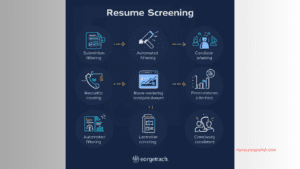
HR does not lack interest — they lack time.
For one single job opening, recruiters often receive 200–1,000 resumes. If they spent even one minute per resume, it would take days just to review one role.
So HR develops a rapid scanning pattern:
-
First 2 seconds – job title & company
-
Next 2 seconds – skills & keywords
-
Next 2 seconds – experience & stability
-
Last 1 second – formatting & clarity
If your resume does not look relevant instantly, it is rejected — even if you are qualified.
This is the hidden reality of the resume screening process.
What HR Looks for in the First 7 Seconds
During resume shortlisting, HR is not reading — they are scanning.

They check:
1. Job Title Match
If the job is for “Accounts Manager” and your resume shows “Finance Executive,” your chances drop immediately unless keywords match strongly.
HR always prefers resumes with titles that closely match the vacancy.
2. Keywords and Skills
Most resumes are filtered through ATS before reaching HR. If your resume does not contain the right keywords from the job description, it may never be seen by a human.
For example, for an HR role:
-
Talent Acquisition
-
Payroll
-
HR Operations
-
Employee Engagement
-
Compliance
Missing keywords = automatic rejection.
3. Relevant Experience
HR checks:
-
Are you doing the same type of work?
-
Is your experience in the same industry?
-
Are you at the right career level?
If a company wants a 5-year Supply Chain Analyst, a 10-year Operations Manager will be skipped — not because they are bad, but because they are misaligned.
4. Career Stability
Recruiters quickly scan:
-
How long you stayed in each company
-
Whether you change jobs frequently
-
Whether you show growth
Too many short stints create red flags in the resume screening process.
5. Resume Structure
Messy formatting, long paragraphs, or cluttered designs slow HR down — and slow equals rejection.
Clear sections, bullet points, and professional layout help your resume get shortlisted faster.
How ATS Changes the Resume Screening Process
Most companies today use ATS software such as Taleo, Workday, or iCIMS.

These systems:
-
Scan your resume
-
Search for job-specific keywords
-
Rank candidates based on match score
Only top-ranked resumes reach HR.
So even before a human looks at your resume, it must pass the ATS filter.
That is why an ATS-optimized resume is no longer optional — it is mandatory.
Why 80% of Resumes Are Rejected Instantly
Here is the insider truth:
Most resumes fail because they are written like biographies, not hiring tools.
-
Generic job responsibilities
-
Missing keywords
-
Irrelevant experience highlighted
-
Wrong job titles
-
Poor formatting
-
No measurable achievements
In the resume screening process, HR does not guess what you can do. They only believe what they see clearly.
How to Make HR Shortlist Your Resume in 7 Seconds
To win the 7-second scan, your resume must be designed for recruiters — not for you.
Here’s how:
Use the Same Job Title
Match your current or recent role with the target job wherever truthfully possible.
Mirror the Job Description
Use the same keywords, skills, and tools mentioned in the vacancy.
Highlight Impact
Instead of: “Handled sales operations”
Write:
“Managed B2B sales operations, generating ₹4.2 crore in annual revenue”
Numbers grab attention instantly.
Keep It Clean
Simple fonts, bullet points, clear headings — no fancy designs.
Optimize for ATS
Avoid tables, graphics, images, and unusual formatting.
Use standard sections like:
-
Professional Summary
-
Skills
-
Experience
-
Education
The Real Goal of Resume Screening
The resume screening process is not about finding the best candidate.
It is about quickly removing the wrong ones.
Your job is not to prove you are perfect — your job is to look relevant in the first 7 seconds.
When HR feels your profile matches what they want, you get shortlisted.
Final Insider Truth
Your resume is not read — it is judged.
Every recruiter decides in seconds whether you move forward or disappear into the rejection pile.
If your resume is ATS-optimized, keyword-rich, clearly written, and role-focused, the resume screening process starts working in your favor.
That is how HR really shortlists resumes in 7 seconds.