
Before Applying for Any Job Online, Keep These Things in Mind to Increase Your Resume Selection Chances
Applying for jobs online is easy. Getting your resume shortlisted is the difficult part.
Many candidates apply to 50–100 jobs but receive very few interview calls. The problem is not always a lack of skills. In many cases, candidates apply for the wrong jobs, use the same resume everywhere, miss important keywords, or fail to check basic job requirements before clicking the Apply button.
If you want better results from online job applications, you need to change your approach.
This guide explains what to check before applying for any job online, how recruiters evaluate resumes, how to improve your resume for a specific job, and how to avoid common mistakes that reduce your chances of getting shortlisted.
1. Don’t Apply Just Because the Job Title Looks Relevant; Keep In Mind Before Applying For Any Job Online
One of the biggest mistakes job seekers make is applying based only on the job title.
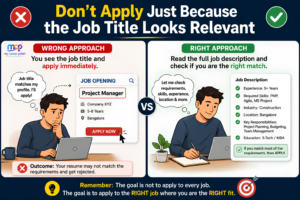
For example, you may see:
“Talent Acquisition Specialist – 3 to 6 Years”
and immediately apply because you have 4 years of recruitment experience.
But before applying, read the complete job description.
Check:
- Required years of experience
- Required industry experience
- Required location
- Required educational qualification
- Mandatory technical or functional skills
- Job responsibilities
- Notice period requirements
- Salary range, if mentioned
- Shift requirements
- Work-from-office, hybrid or remote requirements
Practical Example
Suppose a company is hiring a Solar Project Manager and the JD specifically requires:
- 8+ years of experience
- Solar EPC project experience
- 100 MW+ project execution
- Site management
- Vendor management
- Project scheduling
If you have 10 years of experience but your background is mainly in wind project development, simply having 10 years of experience does not make you a strong match.
Your goal should not be to apply to every job. Your goal should be to apply to jobs where your profile genuinely matches the requirement.
2. Compare Your Resume With the Job Description Before Applying
Before applying for any job online;
This is one of the most useful steps you can take.
Before clicking Apply, open the job description and your resume side by side.
Now ask yourself:
“If a recruiter searches for candidates using this JD, will my resume contain the relevant experience and skills?”
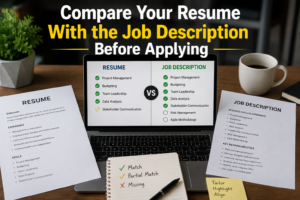
For example, the job description says:
Required Skills:
- Financial Planning & Analysis
- Budgeting
- Forecasting
- Variance Analysis
- Financial Reporting
- Excel
- Power BI
But your resume only says:
“Responsible for finance-related activities and reporting.”
This is too generic.
If you actually have experience in budgeting, forecasting and variance analysis, mention those skills clearly in your resume.
Better Resume Statement
Instead of:
Responsible for financial reporting and analysis.
Use:
Managed financial reporting, budgeting, forecasting and variance analysis to support business performance and management decision-making.
The second version gives the recruiter much more information.
3. Don’t Use One Resume for Every Job
This is probably one of the biggest reasons candidates get poor results from online applications.
Your resume should not be completely rewritten for every application, but it should be relevant to the job you’re applying for.
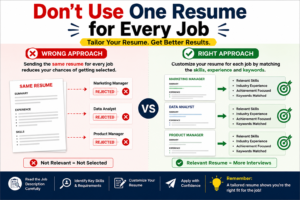
For example, before applying for any job online, if you are applying for:
- Talent Acquisition Manager
- HR Business Partner
- HR Operations Manager
you should not necessarily use exactly the same resume for all three positions.
Your experience may be the same, but the emphasis should change based on the job you are applying for.
For a Talent Acquisition Role
Highlight:
- End-to-end recruitment
- Talent sourcing
- Boolean search
- LinkedIn Recruiter
- Naukri Resdex
- Stakeholder management
- Candidate screening
- Interview coordination
- Offer management
For an HR Operations Role
Highlight:
- HR operations
- Employee lifecycle management
- HR policies
- HRMS
- Payroll coordination
- Employee records
- Compliance
- Onboarding and exit processes
Same candidate. Different positioning.
This is what makes your resume more relevant to the vacancy before applying for any job online.
4. Use Job Description Keywords Naturally
Many companies use Applicant Tracking Systems (ATS) to help organize and filter applications.
But this does not mean you should copy the entire job description into your resume.
Instead, identify the important skills and responsibilities from the JD and check whether they genuinely exist in your experience.
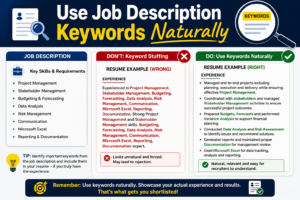
Example
Before applying for any job online, carefully review the job description and identify the important keywords that genuinely match your experience.
Job description:
Experience in recruitment, talent acquisition, stakeholder management, candidate sourcing and interview coordination.
If you have actually performed these activities, your resume can naturally include:
Managed end-to-end talent acquisition activities including candidate sourcing, screening, stakeholder coordination and interview management.
This is much better than creating a separate section containing dozens of keywords.
Important Rule
Before applying for any job online, don’t add a skill just because it appears in the job description.
If you don’t have that experience, don’t falsely claim it.
Use keywords that accurately represent your actual experience and naturally align your resume with the job requirements.
5. Check Your Resume’s First Half Page
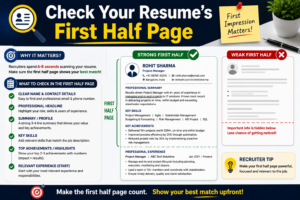
Before applying for any job online, remember that recruiters may receive a large number of applications for one vacancy.
Therefore, your resume needs to communicate your relevance quickly.
Look at the top section of your resume before applying for any job online.
It should ideally answer these questions quickly:
Who are you?
How much relevant experience do you have?
What is your primary area of expertise?
What type of role are you targeting?
For example:
Talent Acquisition Specialist | 7+ Years | Renewable Energy & Corporate Hiring
Then add a concise professional summary mentioning your strongest relevant areas. Before applying for any job online, make sure this summary clearly reflects the requirements of the job you are targeting.
Avoid starting with long paragraphs about your career aspirations.
Weak Example
“Seeking a challenging opportunity in a reputed organization where I can utilize my skills and grow professionally while contributing to organizational growth.”
This doesn’t tell the recruiter much about your actual expertise.
Stronger Example
Talent Acquisition Specialist with 7+ years of experience in end-to-end recruitment, talent sourcing and hiring across renewable energy and corporate functions, including executive and senior-level positions.
The second version immediately communicates your professional identity. This is exactly what you should check before applying for any job online—whether your resume quickly shows the recruiter that your experience and expertise are relevant to the position.
6. Check Whether Your Experience Actually Matches the Responsibilities
Don’t focus only on skills.
Look at the responsibilities mentioned in the JD.
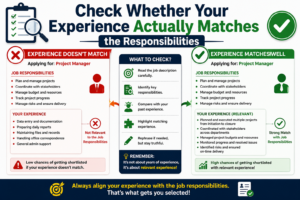
Suppose a company is hiring a PMO Coordinator and the JD includes:
- Project tracking
- MIS reporting
- Dashboard preparation
- Meeting coordination
- Documentation
- Stakeholder follow-up
- Project status reporting
Before applying for any job online, carefully compare these responsibilities with your actual experience.
If your resume only says:
“Worked as a coordinator and supported project activities.”
your relevance is difficult to understand.
If you actually performed those activities, write them clearly:
Prepared project status reports, maintained project trackers, coordinated stakeholder meetings, followed up on action items and supported MIS/dashboard reporting.
Before applying for any job online, make sure your resume clearly highlights the experience, skills and responsibilities that match the job description.
Now the recruiter can quickly connect your previous experience with the vacancy.
Simple Rule
Job description says what the company needs. Before applying for any job online, your resume should clearly show where you have already done similar work.
7. Check the “Deal Breakers” Before Applying
Before submitting your application, check the requirements that can immediately make your profile unsuitable.
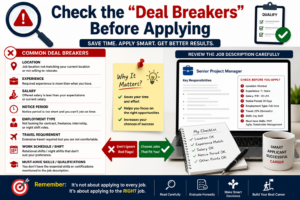
For example:
Location
Job: Bangalore – Work From Office
You: Delhi and unwilling to relocate.
Experience
Job: 8–12 years
You: 2 years.
Qualification
Job: B.Tech/M.Tech mandatory
You: Different qualification with no equivalent experience.
Industry
Job: Pharmaceutical manufacturing experience mandatory
You: Only IT recruitment experience.
Notice Period
Job: Immediate joiner required
You: 90 days’ notice period.
If one of these is clearly mentioned as mandatory, think twice before applying.
This saves your time and helps you focus on opportunities where you have a realistic chance.
A Practical 5-Minute Job Application Method
You don’t need to spend one hour analyzing every vacancy.
Use this simple process.
Minute 1 – Read the JD
Identify:
Experience + Location + Qualification + Mandatory Skills
Minute 2 – Identify the Top Requirements
Write down the 5–8 most important requirements.
For example:
Recruitment + Stakeholder Management + LinkedIn Recruiter + Naukri + IT Hiring + 5 Years Experience
Minute 3 – Compare With Your Resume
Check whether these requirements are clearly visible in your resume.
Minute 4 – Make Minor Resume Changes
Update relevant:
- Professional headline
- Summary
- Skills
- Experience bullets
Don’t change facts. Just improve relevance and clarity.
Minute 5 – Apply
Now submit the application.
This approach is far better than blindly applying to dozens of vacancies.
Should You Apply If You Don’t Match 100% of the JD?
Yes, sometimes.
You don’t necessarily need to match every single requirement.
For example, if a company asks for:
- 5 years of experience
- Recruitment
- Stakeholder management
- LinkedIn Recruiter
- HRMS
and you have 4 years of relevant experience with most of the required skills, you may still be a reasonable candidate.
But if the job requires:
10 years of experience + specific industry experience + mandatory certification
and you meet almost none of these requirements, applying may have a very low probability of success.
Think in Terms of Relevant Match
A strong match is usually more valuable than simply having a long list of skills.
Don’t Forget Your Naukri and LinkedIn Profiles
Your resume is not the only thing recruiters may check.
For many job searches, recruiters also use platforms such as Naukri and LinkedIn to find candidates.
Therefore, your:
- Naukri headline
- Naukri profile summary
- Key skills
- Employment details
- LinkedIn headline
- LinkedIn About section
- LinkedIn experience
should broadly support the same professional positioning as your resume.
For example, if your resume says:
Talent Acquisition Specialist – Renewable Energy
but your Naukri profile says:
HR Executive – Generalist
you are creating confusion about your professional profile.
Keep your professional branding consistent.
The Biggest Mistake: Applying More Instead of Applying Better
Many candidates think:
“If I apply to 100 jobs, surely I will get a job.”
But 100 irrelevant applications may produce fewer results than 20–30 highly relevant applications.
Instead of asking:
“How many jobs did I apply for today?”
start asking:
“How many relevant jobs did I apply for today?”
Track your applications in a simple spreadsheet.
Record:
| Date | Company | Job Title | Match | Resume Used | Status |
|---|---|---|---|---|---|
| 23 Aug | ABC Ltd. | TA Specialist | High | TA Resume | Applied |
| 23 Aug | XYZ Ltd. | HR Manager | Medium | HR Resume | Applied |
| 23 Aug | PQR Ltd. | Recruiter | High | Recruitment Resume | Interview |
After 30–50 applications, you can identify which type of jobs are generating more responses.
Final Job Application Checklist
Before clicking Apply, ask yourself:
- Do I meet the required experience?
- Do I have the important skills mentioned in the JD?
- Does my resume clearly show those skills?
- Is my resume relevant to this specific position?
- Have I included genuine JD keywords naturally?
- Does my recent experience match the role?
- Do I meet the location/work-mode requirement?
- Do I meet the qualification requirement?
- Is my notice period acceptable?
- Are my Naukri/LinkedIn profiles consistent with my resume?
- Am I applying because I’m genuinely a relevant candidate?
If the answer to most of these questions is Yes, your application is much stronger than a random job application.
Final Takeaway
There is no honest way to guarantee that your resume will be selected 100% of the time.
Resume selection depends on several factors, including the number of applicants, recruiter requirements, competition, internal candidates, salary expectations, experience, location and the company’s hiring decision.
However, you can significantly improve your chances by following a job-specific application strategy.
Don’t just apply for jobs. Apply strategically.
Read the JD.
Understand what the company needs.
Compare it with your actual experience.
Customize your resume where required.
Use relevant keywords naturally.
Check the deal breakers.
Then apply.
That small change in your job-search approach can make your applications much more targeted and effective.
Frequently Asked Questions
1. How can I increase my chances of getting my resume shortlisted?
Understand the job description first, match your genuine experience with the role requirements, use relevant keywords naturally, and customize your resume for the position.
2. Should I use the same resume for every job?
It’s better to maintain a strong master resume and make relevant adjustments based on the job description, particularly for the headline, summary, skills and relevant experience.
3. How important are keywords in a resume?
Relevant keywords can help your resume communicate your skills clearly and may also help when companies use ATS or recruiter database searches. However, keywords should always represent your genuine experience.
4. Do I need to match 100% of the job description?
No. You can still apply when you meet most of the important requirements. Focus particularly on mandatory qualifications, experience, location and core skills.
5. Why am I applying to many jobs but not getting interview calls?
Possible reasons include poor job matching, a generic resume, unclear experience, missing relevant keywords, unrealistic applications, profile inconsistency or strong competition.
6. Is an ATS-friendly resume enough to get a job?
No. An ATS-friendly resume is only one part of the process. Your actual experience, skills, job match, application strategy and competition also matter.